Medically Reviewed by Dr. Charles Poblenz on July 15, 2026
What patients notice most: fewer appointments for the same treatment, and they can see what we’re looking at during the exam. Those two things are what the technology actually changed in our practice. Dr. Charles Poblenz and the JAX Dental Studio team use updated diagnostic and restorative equipment across our Jacksonville practice. Fellowship in the Academy of General Dentistry. Schedule your appointment online.
Why We Switched to Digital Impressions
We kept running into the same problem with putty trays: fit variability. Tray came back from the lab. Adjustments needed at seating. Occasionally a remake. We made the switch to eliminate that variable.
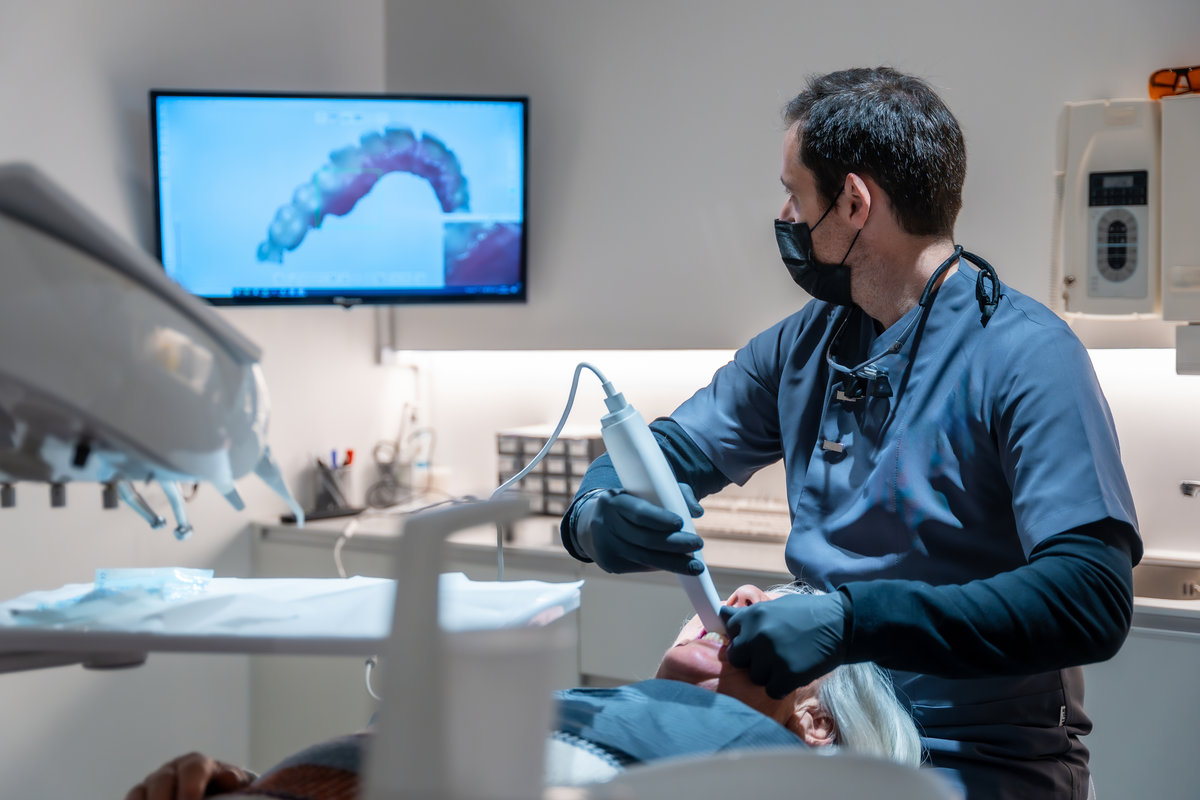
No tray. No setting time. No gag reflex for patients who have one. The file reaches the lab the same day. For clear aligner therapy patients, the scan feeds directly into the planning software. Crowns we place from digital scans: fewer adjustments at seating. Faster appointments overall.
What 3D Imaging Changed About Our Exams
Standard X-rays: still part of every exam. They catch most of what we need. But certain clinical decisions require depth information a flat image can’t give us.
The case that changed our thinking on CBCT: we had an implant planned from standard X-rays, and the 3D imaging showed the nerve in a different position than the flat film suggested. We changed the placement angle. Since then — cone beam CT for every implant case, and for root canals where the anatomy looks complex on standard film. We’ve had cases where what looked straightforward in 2D had branching that only showed up in cross-section.
A conventional X-ray gives a shadow. CBCT gives a map.
Digital X-rays: 70 to 80 percent less radiation than traditional film. Images on screen while the patient is still in the chair. We annotate, zoom, and show the patient what we’re looking at during the same visit. Patients see what we’re looking at — which changes how the conversation goes. For most checkups, digital dental X-rays are all the imaging a visit needs.
Early Detection: What Changes When You Find It Sooner
The math is straightforward. A cavity at 0.5mm: small composite. Same cavity at 2mm: bigger restoration. At 3mm: a crown may be the only option. We use DIAGNOdent — a laser diagnostic tool — for decay that isn’t visible on X-rays yet. We’ve started treatment on cavities that patients had no symptoms from and wouldn’t have known about for a year or more.
Intraoral cameras: when a patient can see the cracked restoration margin on screen — not just take our word for it — the decisions they make are more informed. We’ve had patients who were hesitant about a crown until they saw the crack on the monitor. For preventive dentistry patients, we track gum pocket depths, bite records, and tooth positions visit over visit. Dental sealants go on based on what we find in the clinical exam — fissure depth, decay risk, eruption status — not assumptions.
One-Visit Crowns
Old process: prep the tooth, take the impression, place a temporary, wait two to three weeks for the lab, bring the patient back, numb again, seat the crown. Temporaries fail. The second appointment is time out of the patient’s schedule and a second injection.
We’ve had patients come in expecting two appointments and leave with the permanent dental crown same day. The workflow: prep the tooth, scan, design on screen, mill from a ceramic block. About 15 minutes of milling. Then we seat it. One numb. One visit. For single-tooth restorative dentistry, this is usually the right path. Dental implants use the same CBCT planning tools — placement is more predictable when we’ve measured the bone in 3D before we’re in the chair.
Not every case goes same-day: implant crowns require healing time, large multi-unit cases often go to the lab, some posterior situations are better served by lab fabrication. We say upfront which workflow applies. Patients know what to expect before the appointment.
Does Dental Technology Improve the Dentist Visit Itself?
Faster treatment is one benefit, and comfort is another. Digital imaging, lasers, and sedation options are examples of dental technology improving your dentist visit.
Schedule at JAX Dental Studio
We chose this equipment because of what it produces: fewer patient visits for the same result, restorations that seat better on the first try, diagnostic findings that lead to earlier intervention.
Schedule your appointment online at our Jacksonville office.
Frequently Asked Questions About Modern Dental Technology
What is cone beam CT and when does a dentist use it?
We started pulling it routinely after a case where the standard X-ray gave us one picture and the 3D scan gave us a different one — the nerve was in a position the flat film didn’t show. We changed the implant angle before placement. Since then: cone beam CT for every implant case, and for root canals where the anatomy looks complex on standard film. We’ve had cases where what read as straightforward in 2D had canal branching that only showed in cross-section. We don’t use it for every patient, just when the 3D view would change the plan.
Are digital dental X-rays safer than traditional ones?
Yes — 70 to 80 percent lower radiation than traditional film. The dose from routine dental X-rays was already minimal; digital reduces it further. The second change we noticed in practice: the image is on screen while the patient is still in the chair. We can zoom in, annotate, and show the patient what we’re seeing during the same visit, not hand them a summary at checkout. We take X-rays based on what each visit calls for, not on a fixed schedule.
What is a digital dental impression?
The reason we switched: putty trays came back from the lab with fit issues often enough that we kept adjusting at seating. Occasional remakes. The intraoral scanner eliminated that variable — we scan the tooth in the chair, the 3D model builds on screen during the appointment, and the file goes to the lab or the milling unit that day. Patients who had gag reflex problems with trays notice it immediately. No material in the mouth, no wait, no holding still while something sets. Crowns built from those scans seat better on the first try.
Can I get a crown in one appointment?
For most single-tooth crowns: yes. We’ve had patients come in expecting two appointments and a temporary, and leave with the permanent crown same day. Prep the tooth, scan, design on screen, mill from ceramic block — about 15 minutes of milling — then seat it. One numbing, one visit. Cases that still go to the lab: implant crowns, large multi-unit restorations, some posterior situations where lab fabrication is the better call. We tell patients upfront which workflow applies to their case.
How does technology improve the dental experience for patients?
Two things we hear most. First: no more trays. Patients who had problems with gagging on putty impressions notice the scanner is a different experience — nothing setting in their mouth, no wait, no holding still. Second: being able to see what we’re talking about. We’ve had patients who were hesitant about a crown until they saw the cracked margin on the monitor. They’re making an informed decision at that point, not taking our word for it. Same-day crowns: the feedback is almost always about not needing to come back — one visit, one numbing, done.
About the Author
JAX Dental Studio, Jacksonville, FL
Dr. Poblenz is the lead dentist at JAX Dental Studio in Jacksonville, Florida. Fellowship in the Academy of General Dentistry. Member of the American Dental Association. Over 30 years of combined team experience in general, cosmetic, and restorative dental care for Jacksonville patients.